
Decline Is Gradual. That Is Exactly Why It Gets Missed.
Families rarely miss a crisis. What they miss is the slow slope leading up to it — blood pressure drifting, weight coming off a few pounds at a time, a little more breathlessness on the stairs each month, doses quietly skipped.
Seen day to day, none of it looks like anything. Seen as a trend across three months of recorded observations, it is often obvious — and still early enough to do something about.
Health monitoring is a nurse visiting on a regular schedule, taking the same measurements each time, and writing them down. It is unglamorous work, and it is one of the highest-value things a family can arrange for an ageing parent living with a chronic condition.
A single reading is a number. Twelve readings are a trend — and a trend is something a physician can act on.
Signs That Monitoring Would Be Worthwhile
Health monitoring earns its place where change is likely to be gradual and therefore easy to miss.
A chronic condition that needs watching
Hypertension, diabetes, heart failure or COPD, where the difference between stable and deteriorating is a matter of numbers rather than obvious symptoms.
Recent changes to medication
New prescriptions, particularly for blood pressure, blood thinners or diabetes, warrant observation to confirm they are doing what was intended.
A sense that something is slipping
Families are often right about this before they can articulate why. Monitoring turns an instinct into evidence one way or the other.
Weight coming off
Unintentional weight loss in an older adult is clinically significant and frequently goes unmeasured until it is substantial.
Appointments are months apart
A physician seeing someone twice a year has very little data. Regular observations give them something real to work with.
Living alone
Where there is nobody in the house day to day to notice that things have changed.
What Nursing & Health Monitoring Actually Involves
The service is deliberately systematic. Its value comes from doing the same thing carefully and repeatedly.
Establishing a Clinical Baseline
The first visit is longer than the rest, because everything afterwards is measured against it. We record vital signs, weight, mobility, cognition, appetite, continence, skin condition, pain and mood — and we ask the family what normal looks like for this person.
Normal is individual. A blood pressure that would concern us in one client is unremarkable in another. A person who has always eaten little is different from one whose appetite has halved. Without that starting point, later readings are just numbers without meaning.
- Full baseline clinical assessment
- Documented starting measurements
- Family account of the person's usual state
- Review of existing diagnoses and medications
- Identification of the specific markers to track
- Agreement on visit frequency and reporting
Vital Signs and Physical Measurements
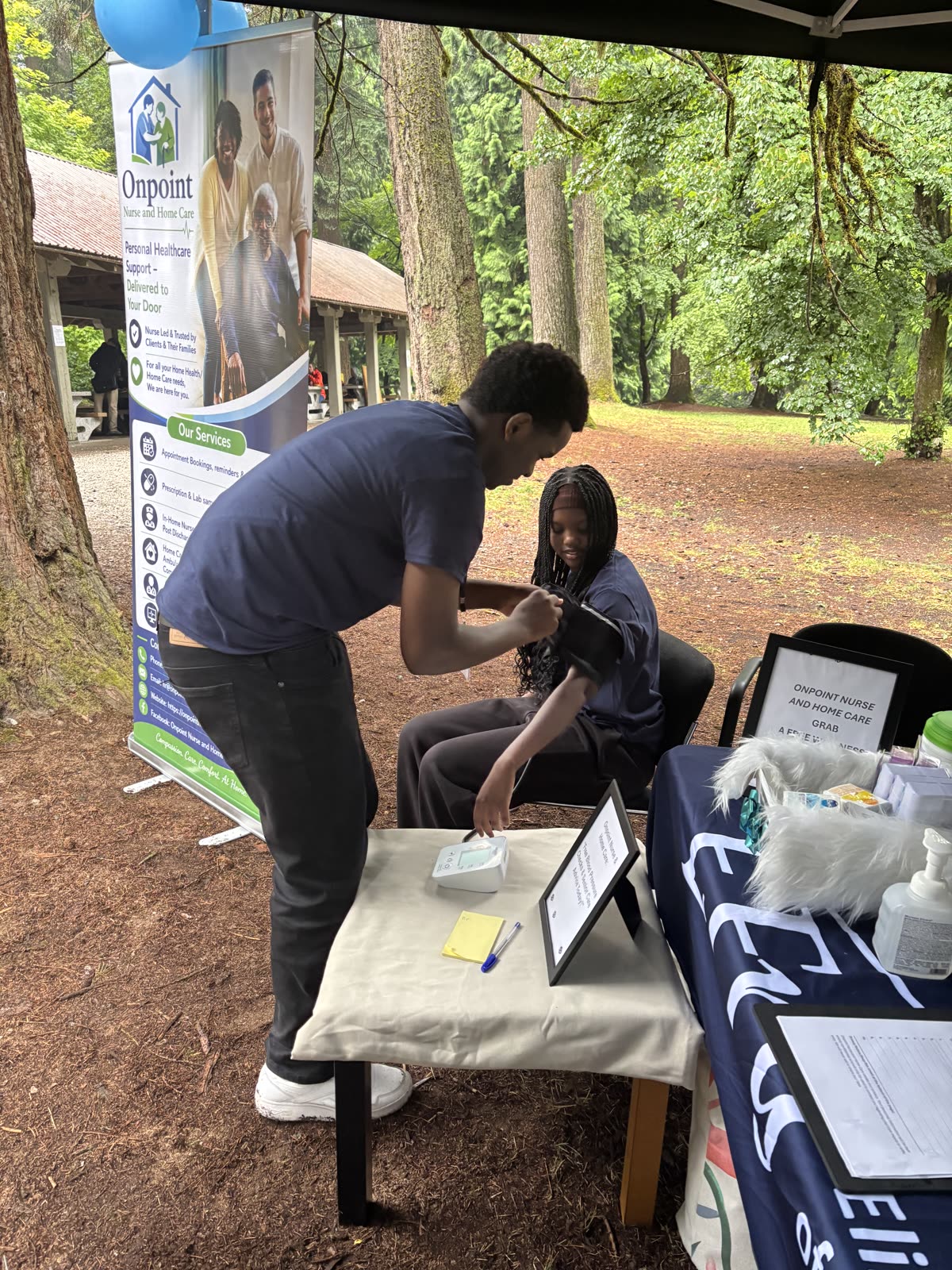
At each visit the same observations are taken, using the same technique, and recorded. Blood pressure, pulse, temperature, oxygen saturation, blood glucose and weight, as the conditions being managed require.
Technique consistency matters more than most people realise. A blood pressure taken standing, after the person has just walked from another room, is not comparable to one taken seated after five minutes' rest — and a spurious trend is worse than no trend at all.
- Blood pressure and pulse
- Temperature and oxygen saturation
- Blood glucose where relevant
- Weight and, where appropriate, fluid balance
- Respiratory rate and effort
- Pain assessment and scoring
Chronic Disease Surveillance
Each long-term condition has its own warning signs, and monitoring is targeted accordingly rather than applied identically to everyone.
For heart failure that means weight, breathlessness and ankle swelling. For COPD it means oxygen saturation, sputum and exacerbation frequency. For diabetes it means glucose patterns and foot inspection. For hypertension it means the trend, not the individual reading.
- Condition-specific marker tracking
- Heart failure: weight, oedema, breathlessness
- COPD: saturation, sputum, exacerbation frequency
- Diabetes: glucose patterns and foot checks
- Kidney disease: fluid balance and symptoms
- Documented deterioration thresholds and actions
Medication Adherence and Effect Review
Prescribing assumes the medication is taken as directed. In practice, adherence in older adults is frequently imperfect — doses missed, doubled, stopped because of a side effect nobody was told about, or continued long after they should have ended.
Our nurses check what is actually being taken, look at whether it appears to be working, watch for side effects, and report discrepancies to the prescriber. A blood pressure that will not come down is a different problem if the tablets are still in the packet.
- Review of what is actually being taken
- Dosette and blister pack checks
- Side effect identification and reporting
- Assessment of whether treatment appears effective
- Reconciliation after any prescribing change
- Direct communication with prescriber and pharmacy
Nutrition, Weight and Hydration
Unintentional weight loss, poor appetite and chronic mild dehydration are among the most under-recognised problems in older adults, and among the most consequential. Dehydration alone accounts for a substantial number of avoidable admissions.
We weigh, we ask honestly about intake rather than accepting reassurance, and we look at the practical picture — what is in the fridge, whether cooking is still manageable, whether dentures fit, whether swallowing has changed.
- Regular weight measurement and trend tracking
- Food and fluid intake review
- Dehydration sign recognition
- Appetite and swallowing changes
- Practical review of shopping and cooking capacity
- Referral onward where intake is inadequate
Reporting to Families and Physicians
The record is the product. After each visit the family receives a written summary; with consent, so does the family physician.
This is what turns monitoring from a reassurance exercise into something clinically useful. A physician with three months of recorded weights and blood pressures can make a decision. A physician with 'she's been a bit tired' cannot.
- Written summary after each visit
- Trend reporting rather than isolated readings
- Reports formatted for physician use
- Explicit flagging of concerning changes
- Escalation according to agreed thresholds
- Support for appointment preparation
Families almost never miss a crisis. What they miss is the six months of small changes that made the crisis inevitable.
Observation With a Purpose
Measurements are chosen against the specific conditions being managed, not taken indiscriminately.
Vital Signs
Blood pressure, pulse, temperature, oxygen saturation and blood glucose, recorded consistently.
Chronic Conditions
Hypertension, diabetes, heart failure, COPD and other long-term conditions observed against their own markers.
Medication Adherence
Whether the regimen is actually being followed, and whether it appears to be causing problems.
Reporting
Written summaries that give families and physicians the same picture, rather than second-hand accounts.
What Health Monitoring Includes
Visits are scheduled at an interval matched to the condition — weekly for something unstable, monthly for something well controlled.
What Is Included:
What a Monitoring Visit Covers
Consistency is the entire point — the same sequence, the same technique, every visit.
How have things been?
An open conversation with the client and family about the period since the last visit, before any measurement is taken.
Observations
Vital signs and condition-specific measurements, taken under consistent conditions.
Medication review
What has actually been taken, whether anything has changed, and whether side effects have appeared.
Wider assessment
Skin, mobility, appetite, continence, mood and cognition — where gradual decline surfaces first.
Report and act
Documentation, a written summary for the family, and escalation where readings cross agreed thresholds.
Conditions We Commonly Monitor
Monitoring is targeted to the specific condition rather than applied as a generic checklist.
How Monitoring Works
Baseline Assessment
The first visit establishes what normal looks like for this person, not for an average person.
Set the Schedule
Visit frequency and the specific measurements are set against the conditions being managed.
Consistent Recording
The same observations, taken the same way, at each visit — which is what makes trends visible.
Review & Escalate
Findings are reported to the family and physician, and acted on when something moves.
What Makes Our Monitoring Worth Having
Trends, not snapshots
A single reading tells you almost nothing. A recorded trend is something a physician can act on.
Consistent technique
Measurements taken the same way each time, because inconsistent technique manufactures false trends.
We look beyond the numbers
Gait, mood, appetite, skin and cognition are where decline shows before the observations move.
Reports your doctor can use
Written summaries formatted to be genuinely useful at an appointment, not just reassuring at home.
Agreed escalation thresholds
Everyone knows in advance what reading triggers what action, so nobody has to improvise.
The same nurse where possible
Familiarity is what makes subtle change noticeable.
Where We Provide This Service
OnPoint Nurse & Home Care serves families across Metro Vancouver. If you are just outside these communities, call us anyway — we will tell you honestly whether we can reach you reliably.
Nursing & Health Monitoring: Common Questions
The measurements themselves may be similar. What differs is consistency of technique, clinical interpretation of what the numbers mean in context, and a written record that a physician can actually use. A nurse also notices the things that are not being measured — a change in gait, a swollen ankle, confusion that was not there last month.
It depends on how stable the conditions are. Something newly diagnosed or recently changed may warrant weekly visits; a well-controlled long-term condition may only need monthly. The interval is set at the assessment and adjusted as the picture changes.
Yes, with your consent. Written summaries are the point of the exercise — they give the physician real between-appointment data instead of a recollection of how the last few weeks felt. Families receive the same information.
The nurse assesses it in context rather than reacting to a single number, escalates to the treating physician where the care plan calls for it, and tells the family what was found and what was done. Where a reading indicates an emergency, they act on it immediately.
Sometimes, yes — particularly where a family has a persistent sense that something is changing but cannot point to what. A documented baseline now is what makes it possible to prove or rule out a decline six months from now, and that evidence is genuinely useful to a physician.
It varies widely. Some arrange it for a defined period after a diagnosis or medication change; others keep it running for years as a long-term safety net for a parent living alone. We review whether it is still adding value rather than letting it run automatically.
Yes. Many families combine monitoring with medication administration, wound care or personal care support so that one visit does several jobs. That is usually better value and less intrusive than separate visits.