
Discharge Is a Handover, Not an Ending
A hospital discharge moves a great deal of responsibility onto a family in a single afternoon. New medications replace old ones. There are follow-up appointments to book, a wound to watch, warning signs to remember, and a person who is weaker than they were a week ago.
Most families manage. But the gap between what was explained at the bedside and what is workable at home on day three is where problems appear — a missed dose, a wound that was not checked, a symptom nobody recognized as significant.
Post-discharge nursing closes that gap. A nurse visits soon after the return home, works through the discharge instructions in the actual house, and stays involved through the recovery window rather than leaving the family to interpret paperwork alone.
The discharge summary tells you what happened in hospital. Somebody still has to turn it into a week that works at home.
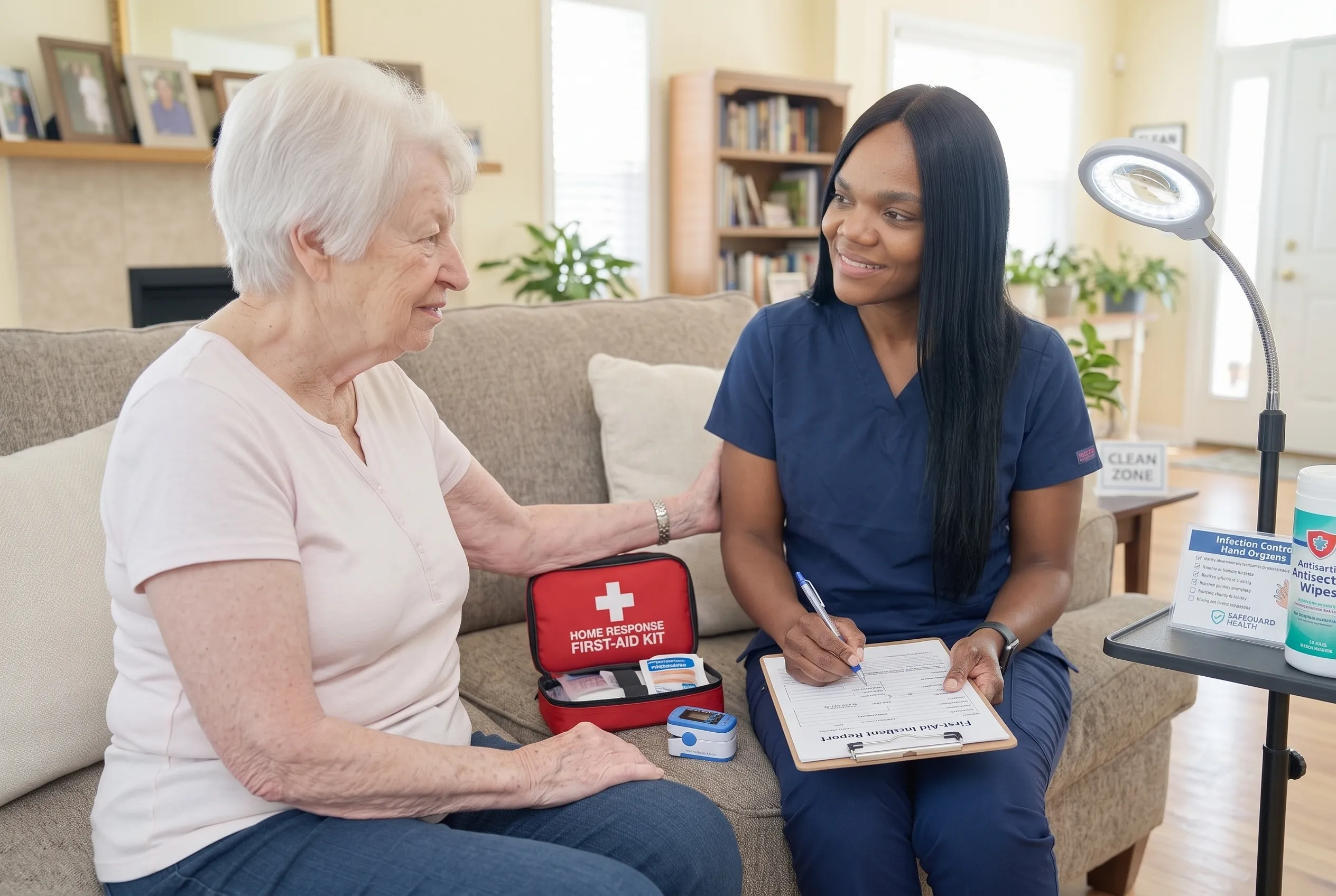
When Post-Discharge Nursing Is Warranted
Not every hospital stay needs follow-up nursing. These are the circumstances where it makes a genuine difference.
The medication list changed in hospital
New prescriptions, stopped medications, changed doses. Reconciling the old list against the new is the single highest-value task in the first week home.
There is a wound or surgical incision
Anything that needs watching, dressing or protecting, where an infection caught late becomes a readmission.
The person is markedly weaker than before
Even a short admission causes deconditioning. Someone who walked to the shop a fortnight ago may not manage the hallway now.
Discharge happened quickly
When instructions were given at the bedside during a busy afternoon and nobody wrote down what was actually said.
There is no confident carer at home
A spouse in their eighties, or an adult child working full time, being handed responsibility for clinical tasks with no training.
It has happened before
A previous readmission within weeks of discharge is the strongest single predictor that it will happen again.
What Post-Discharge Nursing Actually Involves
This is a focused, time-limited service. Every component targets one of the known reasons recoveries fail in the first weeks home.
Translating the Discharge Summary Into a Workable Plan
A discharge summary is written by clinicians for clinicians. It records what happened in hospital and what should happen next, in language that assumes a professional reader and a functioning household.
The first nursing visit takes that document and works through it in the actual home. What does 'mobilise as tolerated' mean when the bathroom is upstairs? What does 'monitor for signs of infection' actually look like on this incision? Which of these six follow-ups is the urgent one?
The output is a plain-language plan the family can follow, and a nursing schedule for the parts they should not be doing alone.
- Full review of discharge documentation
- Plain-language explanation for the family
- Identification of the highest-risk instructions
- Practical adaptation to the actual home
- Written schedule of nursing visits
- Clear list of warning signs and who to call
Medication Reconciliation
This is where most post-discharge problems begin. A hospital stay commonly changes several medications at once. Meanwhile the old packets are still in the cupboard, and nobody has told the community pharmacy.
Our nurses physically go through what is in the house, compare it against the discharge medication list, identify what should have stopped, what is new, what is duplicated under a different brand name, and what has not been dispensed at all. Discrepancies go straight back to the prescriber.
- Physical review of all medications in the home
- Comparison against the discharge medication list
- Identification of duplicates and discontinued drugs
- Confirmation that new prescriptions were dispensed
- Administration support and dosette setup
- Direct escalation of discrepancies to the prescriber
Wound and Surgical Site Monitoring
Incisions and wounds are checked on a defined schedule by someone who knows the difference between normal post-surgical inflammation and the beginning of an infection.
Dressings are changed under sterile technique, the site is measured and documented, and the family is shown what to look for between visits — specifically what warrants a phone call rather than waiting for the next scheduled visit.
- Scheduled surgical site inspection
- Sterile dressing changes
- Documented wound measurement and photography where appropriate
- Early infection sign identification
- Family education on warning signs
- Escalation to the surgical team when indicated
Symptom and Vital Sign Surveillance
The first visit establishes a baseline: what this person's blood pressure, oxygen saturation, temperature, pain level, appetite and mental state look like now that they are home.
Every subsequent visit measures against that baseline. Deterioration in the weeks after discharge is often gradual — a little more breathless each day, eating a little less, a bit more confused — and gradual change is exactly what a family living with it day to day cannot see.
- Baseline observations at the first visit
- Scheduled vital signs monitoring
- Pain assessment and scoring
- Appetite, fluid intake and weight tracking
- Confusion, mood and cognition observation
- Documented trend reporting
Rebuilding Mobility After Hospital Deconditioning
Bed rest costs muscle strength quickly, and older adults lose it faster and regain it slower. Someone discharged after a week of illness is frequently at real risk of a fall in their own home — a fall that would put them straight back on a ward.
Nursing support means supervised movement at a safe pace, a reassessment of fall risk in the current condition rather than the pre-admission one, and practical adjustments to the house while recovery is happening.
- Post-admission fall risk reassessment
- Supervised mobility and safe transfers
- Home hazard review in light of reduced strength
- Equipment and aid recommendations
- Graded activity progression
- Coordination with physiotherapy where involved
Follow-Up and Appointment Coordination
Discharge usually generates a list of follow-ups: a surgical review, blood work, a specialist appointment, a family physician visit. Each one exists for a reason, and each one is easy to lose in a difficult few weeks.
We help keep that list visible, prepare for the appointments so the clinician gets useful information, and make sure the results of our own monitoring reach the people making decisions.
- Tracking of scheduled follow-up appointments
- Preparation of observations for review appointments
- Written summaries sent to the family physician
- Coordination with specialists and clinics
- Handover to ongoing services where needed
- Clear discharge from our own service when appropriate
Readmission is rarely caused by one dramatic event. It is usually four small things that nobody joined up.
What We Watch For After Discharge
These are the four areas where a straightforward recovery most often turns into a return to hospital.
Medication Confusion
Discharge usually changes the medication list. We reconcile old against new and make sure the routine is understood.
Wound & Incision Sites
Surgical sites and pressure areas are checked on a schedule, with early infection signs escalated promptly.
Unnoticed Decline
Appetite, fluid intake, breathing, pain and confusion are tracked against the baseline set on the first visit.
Follow-Up Slipping
Appointments, tests and specialist reviews are only useful if they actually happen. We help keep them on the calendar.
What Post-Discharge Nursing Includes
This is a time-limited, intensive service. Most families use it for the first two to six weeks home, then either step down or stop.
What Is Included:
How the First Two Weeks Usually Run
The exact schedule depends on the assessment, but this is the shape most post-discharge plans take.
Before discharge, where possible
A conversation with the family — or the discharge planner — so that the plan starts before the person is already home and struggling.
First visit, within days of homecoming
The longest visit. Baseline observations, medication reconciliation, discharge summary review and a written plan.
Early frequent visits
More often at the start, when risk is highest, tapering as the picture becomes clearer and more stable.
Mid-point review
A step back to ask whether recovery is going as expected, and to change the plan if it is not.
Step down or discharge
Reduce to periodic monitoring, hand over to ongoing home nursing, or close the file and say so plainly.
Admissions We Commonly Follow Up
Post-discharge nursing is shaped around the reason for the admission, not applied identically to everyone.
How the Handover Works
Before or At Discharge
Where possible we speak with the family — or the discharge planner — before the return home.
First Visit, Fast
The initial nursing visit is scheduled close to the homecoming, while instructions are still fresh.
Recovery Window
Regular visits through the period of highest risk, with notes after each one.
Step Down or Continue
As recovery stabilizes we reduce visits, move to ongoing monitoring, or close the file.
What Makes Our Post-Discharge Support Different
We start fast
The value of this service is concentrated in the first days home, so that is where we put our scheduling priority.
Medication reconciliation as standard
Not an optional extra. It is the first thing we do, because it is where most problems originate.
Baseline before trend
We establish what normal looks like for this person now, so deterioration is measurable rather than a matter of opinion.
We work with discharge planners
Referrals from hospital teams are welcome, and we coordinate rather than duplicating what is already arranged.
Time-limited by design
This is not a service we try to extend. When you no longer need it, we say so and step back.
Reachable between visits
Recovery questions do not arrive on schedule. There is a number to call when something changes.
Where We Provide This Service
OnPoint Nurse & Home Care serves families across Metro Vancouver. If you are just outside these communities, call us anyway — we will tell you honestly whether we can reach you reliably.
Post-Discharge Nursing: Common Questions
We aim to have the first visit close to the return home, because that is when instructions are freshest and risk is highest. Call us as soon as a discharge date is known — even a day or two of notice makes scheduling considerably easier.
Yes. We accept referrals from hospital discharge planners, social workers and community clinicians, as well as directly from families. If a discharge planner is coordinating, they can reach our care team on the number above.
Commonly a few weeks — long enough to get through the period where readmission risk is highest and the new routine has settled. Some clients then step down to periodic health monitoring; others stop entirely. We will tell you when we think you no longer need us.
The nurse documents what they observed and escalates according to the care plan — to the treating physician, to the family, or to emergency services if the situation calls for it. Families are told what was found and what was done about it, not left to discover it later.
Some clients are allocated publicly funded home health support after discharge, and the amount varies with assessed need. Many families find there is a gap between what is allocated and what the situation actually requires, and use private post-discharge nursing to fill it. We coordinate with the funded team rather than duplicating their visits.
We cannot provide care on a hospital ward, but we can and do speak with families and discharge planners beforehand. Doing so means the first home visit is already booked, the house has been thought about, and nobody is making arrangements on the day.
That is a perfectly normal way to use this service, and for many families it is exactly right. There is no expectation of a long arrangement — the point is to get through the risky window safely.